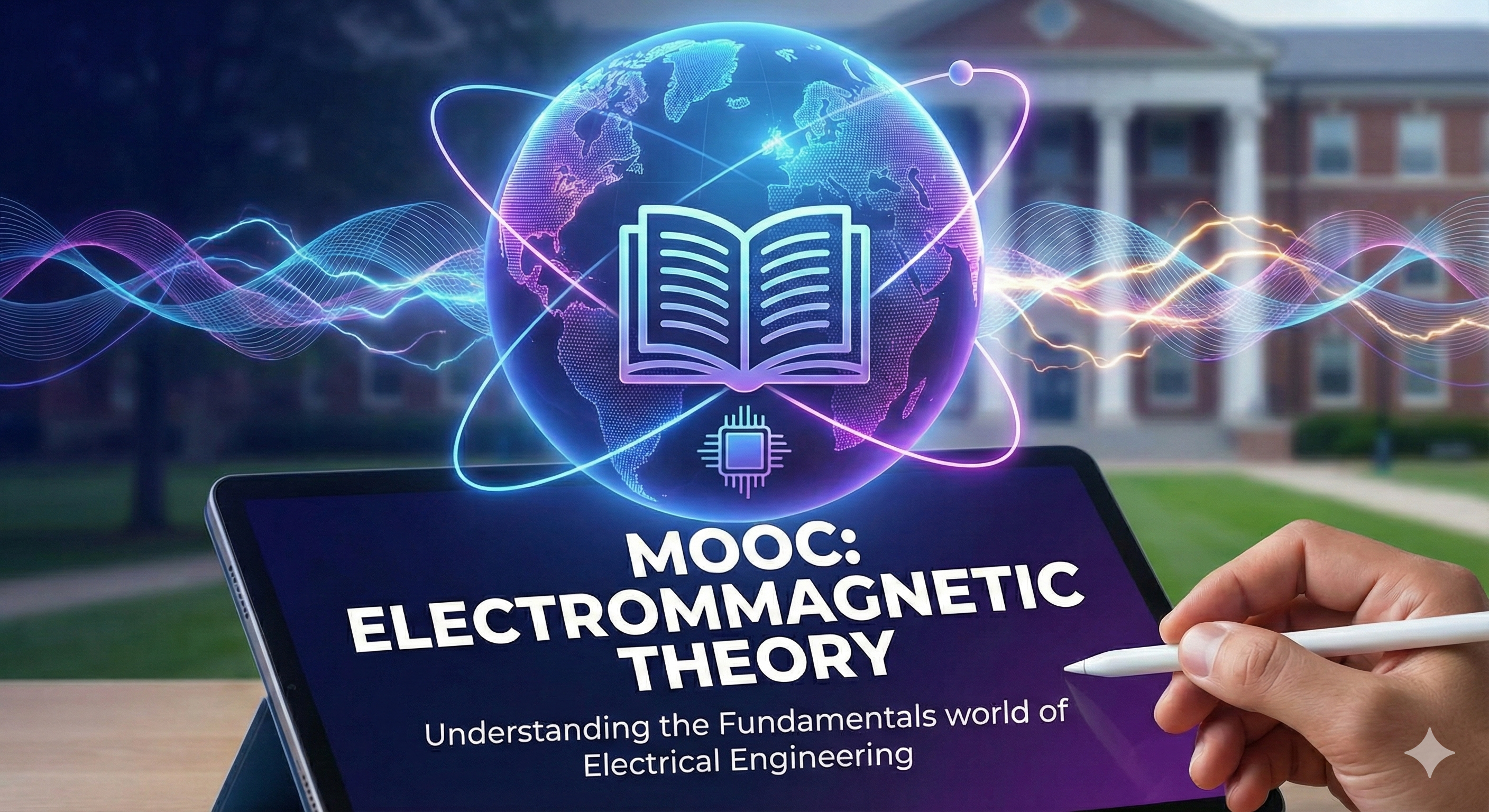
This MOOC aims to offer an engaging and structured introduction to engineering electromagnetics (EM), suitable for junior and senior-level engineering students. The course is designed to make complex EM concepts more accessible and interesting through a progressive learning structure, supported by real-world applications and interactive problem-solving.
Course Highlights:
-
Foundational Vector Analysis First
-
Vector analysis, the mathematical backbone of EM, is taught at the beginning and gradually applied throughout the course to maintain conceptual flow and avoid disruptions.
-
-
Contextual Learning with Modern Themes
-
Each module begins with a modern application, linking theory with real-world relevance and previous lessons.
-
-
Student-Centred Explanations
-
Clear definitions of key terms, boxed formulas, and step-by-step solved examples build student confidence and aid comprehension.
-
Practice Exercises immediately follow each example to reinforce learning.
-
-
Assessment and Feedback
-
Every module concludes with multiple-choice review questions (with answers) to encourage immediate feedback and concept reinforcement.
-
A wide range of problems, including varying difficulty levels (* and **), support self-paced and instructor-led learning.
-
-
Balanced Emphasis on Static and Dynamic Fields
-
Both static and time-varying electromagnetic fields are explored in detail, reflecting their significance in modern industries such as computing and imaging.
-
-
Real-Life Applications
-
Each module ends with real-world applications of the chapter’s concepts, helping learners bridge the gap between theory and practice.
-
- Teacher: Lam Hong Yin
- Teacher: Azli Nawawi
This course provides an overview of product development, tracing its evolution from the pre-industrial era to the modern age. It emphasizes the importance of understanding customer needs and translating them into functional requirements. This course also introduces the concept of functional decomposition, which involves breaking down a complex product into smaller, manageable components. Finally, it discusses the process of product concept development, including idea generation, evaluation, and refinement.
History of Product Development (Promo video)
- Teacher: Azli Nawawi

The product design stage is the most crucial stage in the manufacturing process because it relates directly to the effectiveness of the manufacturing enterprise. A well- made design will save time and other resources and from here, it is very important for the students to learn to implement product design in the right way.
- Teacher: Azli Nawawi

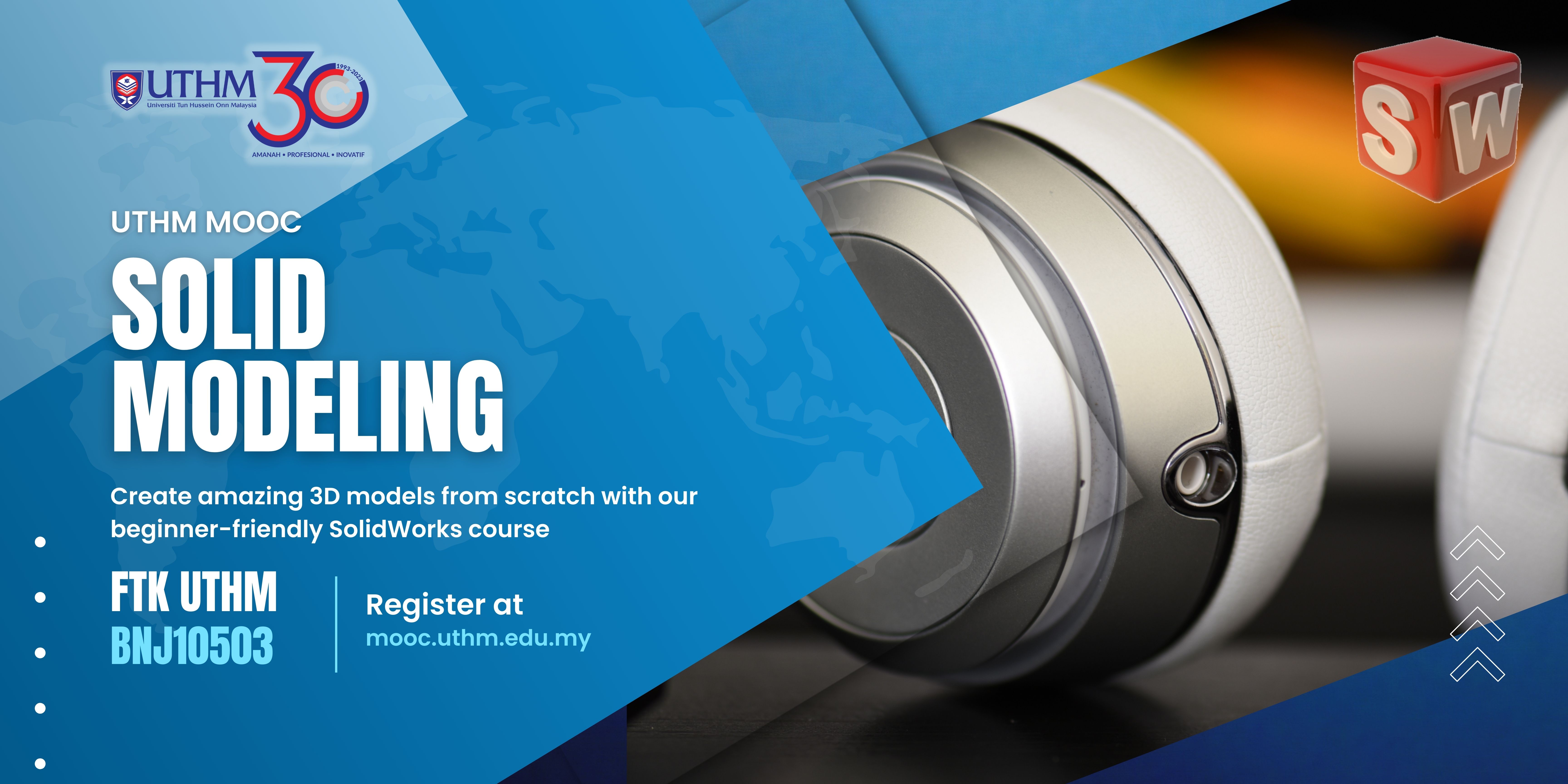
This course covers the crucial points for building 3D models. Solidworks software will be used throughout the course. You will learn to draw a sketch, develop 3D models, assemble a product, perform assembly analysis, making animation and implement finite element analysis.
- Teacher: Azli Nawawi

This course introduces students to knowledge and skills in occupational safety and health in the workplace. Scope of study includes Health, Safety and Environment Managements, Risk Management and Assessment, Physical Injury & Controls, Health Hazards, Accident Investigation & Reporting.
Course Learning Outcome(s):
At the end of this course the student will be able to:
| CLO 1 | Apply safety and health program to meet the workplace requirements. (LOD 1, PLO1, C3, SK2, SK3, SK4, SP1, SP2, SP3) | |||||||||||||||||||||||||||||||||
| CLO 2 | Perform safety procedures with the application of personal protective equipment according to the working environment. (LOD 5, PLO 5, P4, SK3, SK6, SP1, SP3, SP4) | |||||||||||||||||||||||||||||||||
| CLO 3 | Adopt current technique on reporting of accident/incident according to OSHA 1994, FMA 1967 or DOSH requirements. (LOD 15, PLO 8, A3, SK7) | |||||||||||||||||||||||||||||||||
| CLO 4 | Integrate concept of safety and health program with professionalism and society issues. (LOD 16, PLO 6, A3, SK3, SK6, SK7, SP1, SP5, SP6) | |||||||||||||||||||||||||||||||||
- Teacher: Nik Normunira Mat Hassan
- Teacher: Nur Faezah Yahya
Dynamics (BNJ20103 & BNT20103 are the course code for UTHM students)
Course Synopsis
This course will cover the kinematics of particles, kinetics of particles, kinematics of rigid bodies and kinetics of rigid bodies. These essential topics in dynamics will provide students with proficient theoretical and application background in dealing with particles and rigid bodies.
*This course is for internal use of UTHM students only. Not for sale or profit.
- Teacher: Nor Afzanizam Samiran
- Teacher: Tze Mi Yong

The aim of this course is to provide students with knowledge and the application of design for manufacture and assembly concept in manufacturing.
- Teacher: Azli Nawawi